How to Tell When Pears Are Ripe Without Picking Them Too Early
Pears are the awkward one in the fruit garden. An apple will practically tell you when it is ready: crisp, coloured, and it drops into your hand with a twist. A pear can look ripe, feel ripe, and still be hard as a pebble at the core — or feel pleasantly firm and be quietly turning to mush inside. Get it wrong and you either pick a month early and wait for something that never sweetens properly, or leave it a day too long and find the fruit has gone grainy and brown at the heart.
The good news is that pears give you several signals at once. Learn to read them together and you will stop guessing.
Pears ripen from the inside out. The core softens first, while the outer flesh stays firm long after the middle has given up. That is why a pear that feels perfect in your palm can already be past its best inside.
Most European pears — Conference, Concorde, Williams, Comice, Beurré Hardy — should be picked when they are mature rather than ripe. Mature means the seeds are fully formed and the sugars are built, and the fruit will finish ripening off the tree. Ripe means ready for the plate. Left on the branch to soften, a pear often goes mealy or rotten at the centre before the outside catches up.
Asian pears, such as nashi, are the exception. They ripen on the tree and are eaten crisp and juicy, so the advice below mostly applies to European varieties. Worth knowing which you are growing before you start squeezing fruit.
If you only ever learn one trick, learn this one. Find the neck of the pear — the narrow section between the stalk and the fat body of the fruit. Cup the pear in your hand and press gently with your thumb just below where the stalk joins.
Test several fruits rather than one, and test fruit from different parts of the tree. The sunniest, most exposed pears at the top and outside of the canopy finish first. Whatever you do, do not squeeze hard — bruising does not show up immediately, but appears days later as brown patches under the skin.
A red flush is a poor guide. On many varieties it appears weeks before the fruit is anywhere near ready, which is why gardeners who pick on blush alone end up with a kitchen full of hard pears.
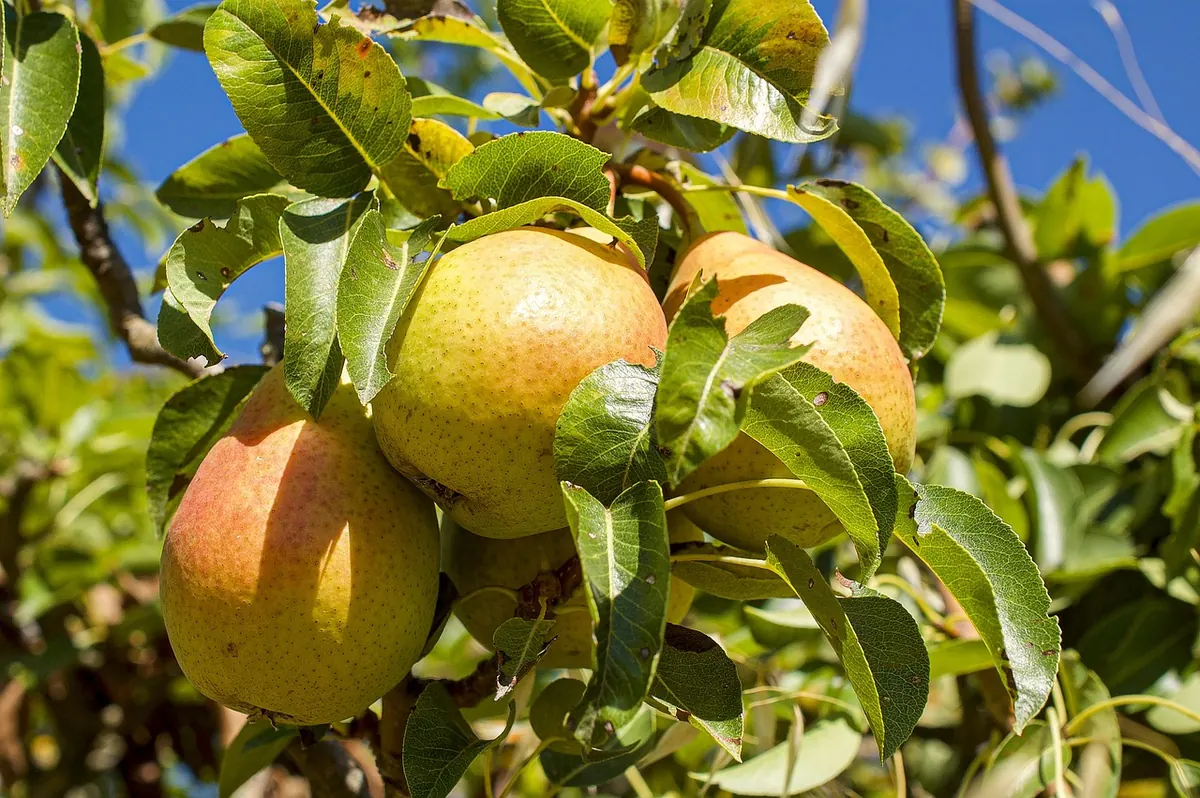
The ground colour is the background skin colour, best judged around the stem and on the shaded side of the fruit. As a pear matures, that green dulls and shifts towards a lighter, paler shade, often with a warm yellow undertone behind it. You will also notice the lenticels — the small dots across the skin — becoming more prominent and darker, and the surface losing its flat, matte look.
Varieties behave differently. Conference goes dull yellow-green with a bronze flush. Williams turns pale yellow. Comice holds its green longer than most. Russet types such as Bosc move from green-brown to a warmer bronze. The real skill is learning your own tree's progression and writing it down year on year, because garden conditions change the timetable considerably.
Once the neck gives slightly and the colour has moved, it is time to pick. Pears should never be pulled straight off the branch, and never yanked by the stalk.
If it takes real effort, or the stalk snaps and leaves the fruit hanging, it is not ready. Leave it alone and try again in two or three days. Pears ripen unevenly across a single tree, so expect to harvest over two or three weeks rather than in one afternoon. Start with the fruit at the top and on the sunny side, and work down and inwards.
A windfall is not a reliable signal — by the time a pear drops on its own it is usually over-ripe. That said, a sudden flurry of interest from wasps and birds often means the fruit is sweetening, so start testing daily if the tree gets busy.
A mature pear smells sweet and faintly floral close to the stalk. A pear with no scent at all is usually not ready; smell is a useful second opinion, not a first one.
Handle picked fruit as though it will bruise, because it will. Place pears gently into a shallow tray or box lined with newspaper, in a single layer if you have room. Cool conditions slow ripening down, so a garage, shed or the salad drawer of the fridge works well for holding fruit you are not ready to eat. Bring a few out at a time to ripen at room temperature, checking daily, and eat them as they soften from the neck down. A ripe banana or apple in the same bowl will speed things along.
If a pear refuses to soften at all and turns rubbery instead, it was picked too early or held too cold for too long. Ripening cannot be undone or forced once that happens.
When you head out to the tree, run through these in order:
Pick a few, leave the rest, and taste what you have taken. Adjust the timing of the next picking by a couple of days in whichever direction the fruit tells you. After a season or two of this, judging pears stops feeling like guesswork and starts feeling like a conversation with the tree.
Photo: Πασκαλ / Pixabay
Previous Post
Common Mistakes When Feeding Raspberry Canes
Next Post
A UK Fruit Harvest Calendar: What to Pick Each Month